


Our research
The research behind doddl
doddl products are backed by years of research and development — involving child development experts, occupational therapists, ergonomic engineers, materials scientists and children. Our research is ongoing.
Where it started
The first doddl prototypes were made from broken plastic cutlery ends and clay — shaped to test whether compact, ergonomic handles were genuinely easier for children to use. They were tested with local children. The results consistently showed the same thing: children found compact, palm-fitting handles significantly easier to control.
The formal R&D programme
doddl built a formal research and development programme, bringing together specialists across child development, ergonomics, materials science and manufacturing:
- Norland College — Child development expertise, led by Claire Burgess
- Exeter University — Materials specialist research department
- CALMARE — Centre for Alternative Materials and Remanufacturing Technologies
- SWMAS — South West Manufacturing Advisory Service
- Engineering Innovation Network — CAD and product prototyping expertise
How we tested
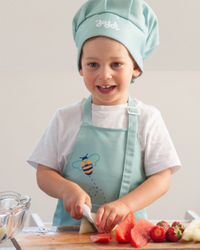
Controlled testing involved children in structured, filmed sessions completing measurable tasks: scooping peas (spoon control), stabbing pasta (fork precision), cutting banana (knife control). Control groups used standard cutlery; doddl groups used prototypes. All sessions were filmed and analysed alongside child development specialists.
What the research showed
- Children aged 6 to 30 months do not have the wrist strength, grip control or coordination to use long-handled cutlery effectively
- Standard children's cutlery is a scaled-down adult product — the wrong starting point for a developing hand
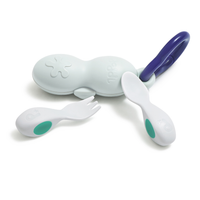
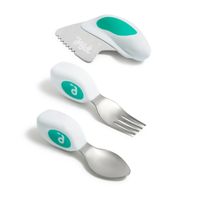
- A compact, palm-fitting handle lets children use their whole hand for grip, dramatically reducing frustration and food loss
- Metal utensil ends are essential beyond initial weaning for a successful transition to adult cutlery
- Handle size should be based on the average two-year-old hand
We never stop investing in research
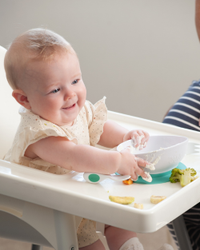
An ongoing study in nursery settings is looking at how doddl changes mealtimes. Early observations from nursery staff:
- Children eat more vegetables when using doddl equipment
- Staff can monitor food intake more accurately in real time
- The doddl plate design visibly increases concentration at mealtimes
- Children can eat more liquid foods (i.e soup) — often abandoned with standard tableware
- There is more advanced bilateral coordination in children who use doddl
Every new product. The same process.
No doddl product reaches manufacture without being tested, validated by experts, and independently safety-checked. That is not simply a policy. It is how doddl works.